THE BLUE FEATHER

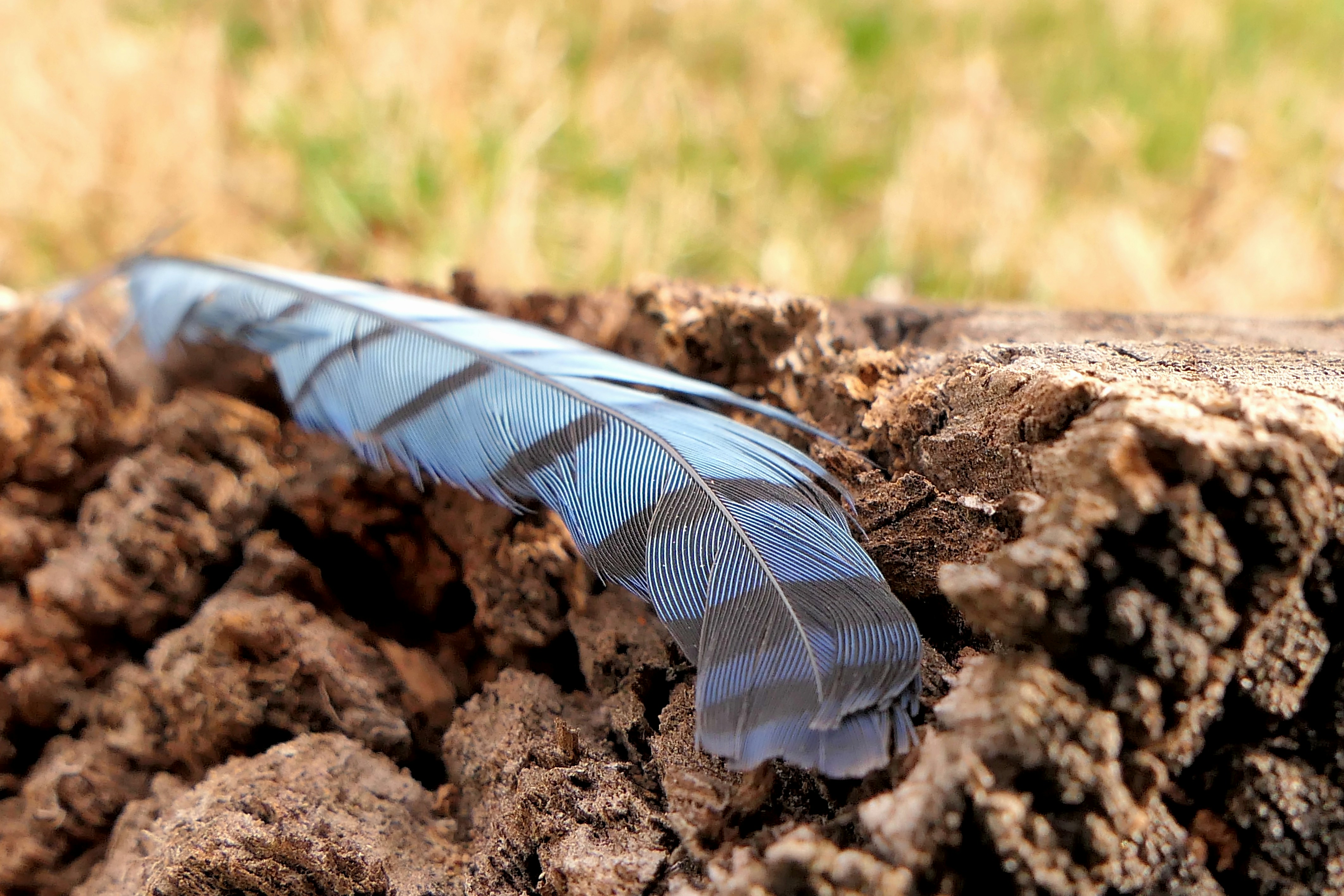
A close-up of a blue feather resting on a textured piece of wood, with a blurred green background.

I was picking up dead tree branches in the front yard this morning. Not all of them — I’m too lazy for that — but the larger ones, the ones you can see from the road, I picked those up. To get to them I had to crawl under the canopy of trees in our front yard. Nestled on the dirt amongst the branches was four-year old bark that was in the process of returning to the earth, green vining vinca, and a clump of lamb’s ear that flowers pink in the summer. 

There were also pine cones, pine needles, disintegrating leaves, moss, and about a million maple “helicopter seeds.” I know come next spring I’ll spend at least three hours uprooting their tiny volunteer maples. But that isn’t what I’m thinking about today. 

Today, I’m thinking about something else that was tucked into the array of dirty things. 

A small blue feather. 

Brilliant navy blue with a small section of black. Just one glimpse told me it was from a Steller’s Jay. Instantly, I thought back to my childhood and Lys. 

Lys lived two houses down. She was older and widowed. A retired school teacher, it seemed like she was almost always home, or at the very least out in her expansive yard. Her garden was a delight — flowers, vegetables, fruiting trees, and a wall of blackberries. She was generous and shared frequently. I remember summer days spent with buckets by those blackberry bushes, eating every other berry as my mom, sister, and I collected the ripest fruit to turn into jam, pie, and fruit leather. 

As a teacher by trade and in her heart, Lys was constantly teaching me. She saw in my childhood soul a love for animals and nature, and she fostered it. 

She often invited me into her two-bedroom cinderblock home where she kept collections of things she’d found out in the world. A shed snakeskin, interesting rocks and agates, small pieces of beached driftwood, and feathers. Oh the feathers. To my childhood eyes her collection was massive. She remembered where she found each one and what type of bird they had all fallen from. 

When she found feathers she had in her own collection she’d grab them for me, handing them over, telling me the proper names for each bird and pointing to them if they happened to be in the yard.

She’s the one who taught be about the Steller’s Jay — and their proper name. 

I imagine it’s because I watched so many Disney movies, but when I saw those blue birds in our neighborhood, that’s what I called them — blue birds. 

Hearing me say it only once, Lys told me that they weren’t blue birds. Those didn’t actually live in our area — but instead we have Steller’s Jays. She pulled out her Audubon bird book with the red cover and helped me turn to the page where I could read all about Steller’s Jays. 

It wasn’t a harsh correction, but gentle and kind, inspiring me to want to know more about the birds in our area. I sat mesmerized, flipping through the colored pictures of birds, imagining the joy of someday seeing each one in the wild. 

That’s who Lys was — a lover of all things natural and wild. She volunteered at the zoo, which as an elementary school student I thought was the best thing ever. She also volunteered at a nature preserve with a small lake and trails. She took me there at least once. I think my sister might have been with us.

In my eyes, Lys was somewhat of a superhero. But as often happens with childhood superheroes, as I went into Middle School and High school, I became focused on more practical things. I’d still see Lys occasionally, but the years had stolen some of her memory and her aging body seemed to keep her from being in her yard as much. At least that’s what I’d like to think. The reality is, I probably just gave me attention to things I thought were more pressing and important. 

Sad, but true. 

I remember my parents telling me when Lys had been diagnosed with Alzheimer’s. I was out of the house, trying to figure out what it meant to be an adult. Later, her kids moved her into a care facility near them, and then she eventually left this earth. 

I don’t remember how long ago it was she died. Decades at this point. Her house has had two different owners, the current one is putting on an addition. The front garden is gone. The blackberries are, too. But my fond memories of Lys remain.

I’m thankful for the neighbor she was. 

I’m thankful she shared her passion with all things natural and wild with me. 

I’m thankful for all the feathers she gave me, now lost to time, which were always a reminder that she was thinking of me.

She saw me. She loved me. 

And I’m thankful for all that she taught me, not only about being a neighbor, but about the beauty of critters and creation and plants. 

I wish she was still here so I could tell her. I wish I could go over to her house and find her pulling weeds in the front yard. 

I wish I could tell her how often I think about her, all these years later. 

But even though I can’t, I can still live out what she showed me. I can care for the earth, take delight in nature, be amazed by the beauty of birds and feathers. I can feed the hummingbirds, pick blackberries, share what grows in my garden, and give thanks for a woman who knew how to love her neighbors. Even an awkward little girl with glasses and an eye patch who was happier searching for frogs than going shopping. 

I don’t know what type kind of relationship Lys had with God. But I hope I get to see her again. I imagine if she’s in heaven, like I hope she is, she and Wendell Berry are having some incredible conversations. Conversations I hope I get to listen to some day. 

Until then, whenever I see a Steller’s Jay, or one of their forgotten feathers on the ground, I’ll think of Lys and smile. 

DON’T BE LIKE THEM

This might sound dramatic, but I think it’s true. 

The world started falling apart the moment someone said, “I want to be like them.”

Hear me out. 

The problem of sin and brokenness starts — and continues — with God’s people to wanting to be something (or someone) other than what they are. 

It starts in the garden, with the serpent tempting Eve with the promise of being someone else. 

“You can be like God. You can know everything. Don’t settle for being reliant on him.” (Genesis 3:5) 

And Eve falls for it. So do I. I’m guessing there are times you’ve fallen for it, too. 

Another place where we see this problem (it’s all throughout scripture) is in Genesis 16. 

God has promised Abram that He will make him into a great nation. Sarai, Abram’s wife, doesn’t seem to be able to have children. She’s not happy with the situation she’s in — with the place God has her — so she comes up with a plan that will make her the mother she wants to be. She tells Abram to sleep with her maid servant, Hagar. He does and Hagar has a baby, Ishmael. 

Sarai gets even more jealous and things start to go south quick. And they keep going. By the time we get to 1 Samuel, people aren’t even disguising the fact that they don’t want to be who they were created to be. 

“Give us a king,” the Israelites, God’s chosen people, say. “We want to be like all the other nations.” (1 Samuel 8:19-20)

As I read that passage, something clicked deep inside me, and I had to stop and sit with the feeling for a moment. 

How many times have I wanted to be like “them”? To be someone other than I was created to be? To be in a place other than the one God had placed me at that specific time?

Way more than I can even begin to count. 

But what if, instead of looking for ways to fit in, I let God allow me to stand out in whatever ways He wants? 

Living that way is counter-cultural, especially in our media and marketing-driven society. 

Many of the messages that bombard us every day are crafted to tell us that not only can we be someone else, but we should be. And if we don’t want to, there’s something wrong with us. 

Don’t get me wrong. Dreams and aspirations aren’t bad, but where those dreams and aspirations come from matters. 

Often, the root is that we want to live a life other than the one we have. 

We want to look different than how God hand-crafted us. 

We want to be someone other than who we were created to be. 

And that’s the real tragedy, because what if you already are who you were meant to be? 

I believe with every part of me that God has a unique call for your life. You reflect Him in a way no one else can. Are you leaning into that? 

God isn’t cruel. In fact, He often gives us what we want. But what if, instead of wanting to be like someone else — or everyone else — you wanted to be more fully you? The unique, beautiful one-of-a-kind you that you were created to be?

What if we all did? 

CONSIDER THE SQUIRRELS

One of the first things we bought when we moved into our current house was a matching pair of padded chairs. We hadn’t been looking but stumbled upon them at Costco with the tell-tale “closeout” asterisks on the price tag and a price that was hard to beat. 

Erik called my brother-in-law, who had a truck, and later that afternoon, the chairs were dropped off at our new home. 

Without even unwrapping them I knew where they would go. We have a large bay window that desperately needed seats and this value-priced set was perfect. We threw away the boxes, screwed on the feet, and set them side by side in their new home with a small table settled in between. 

Very quickly, the chair on the left became my morning chair. Each morning, cup of jasmine tea in hand, I’d settle in with a blanket and stare out the window. More often than not, within ten minutes I’d be giggling. 

“You sitting in those chairs and giggling is one of my favorite things about this house,” Erik said.

What was I giggling at? 

Squirrels. 

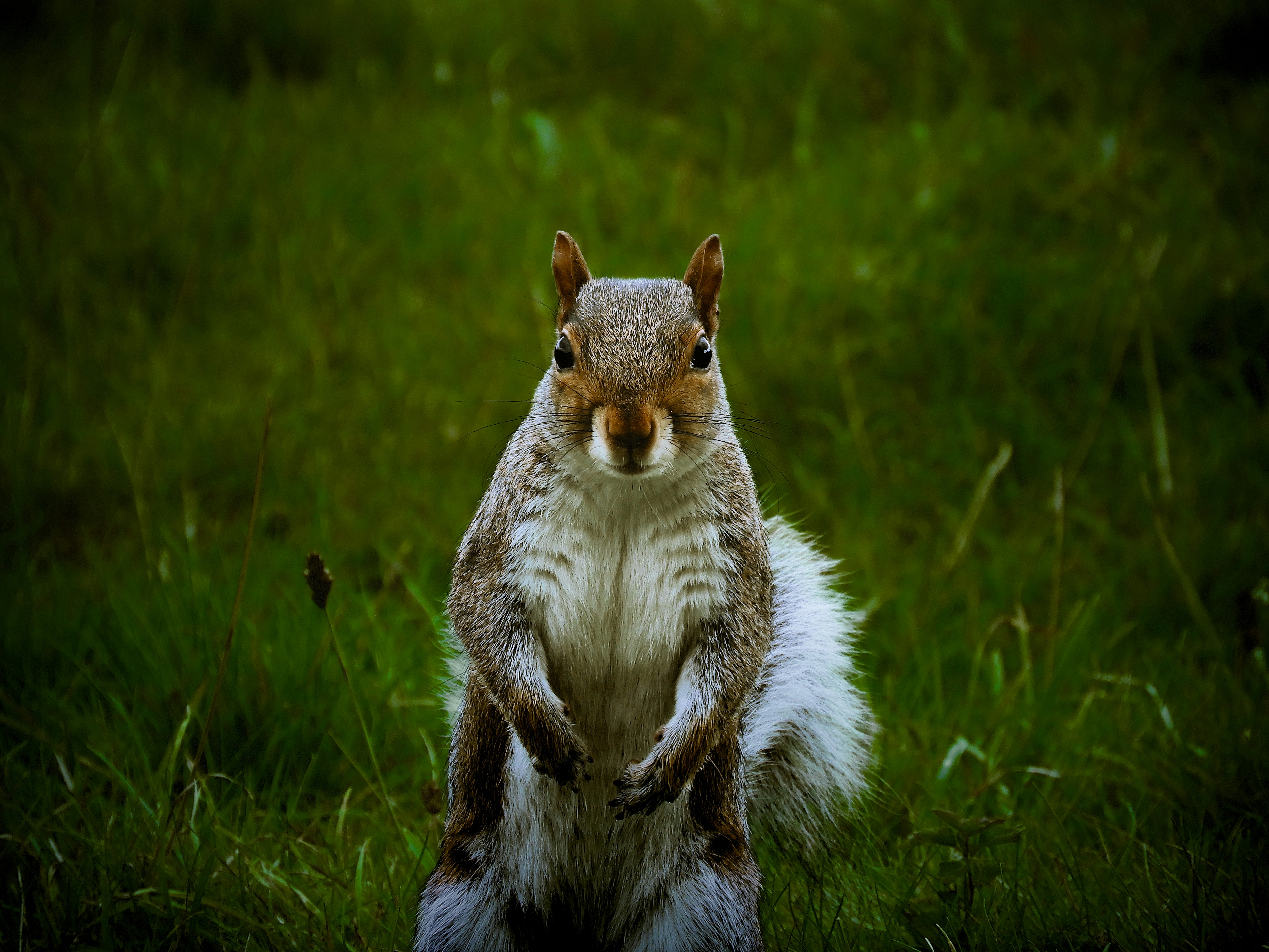
The cluster of tall trees that the bay window looks out on is  home to at least one colony of squirrels. Most mornings, they scamper their way over the branches and down the trunks to our front yard patch of lawn. What they do then is rather extraordinary, and I can’t witness it without giggling. 

The squirrels play as if nothing else in the world matters. 

Sometimes in pairs, sometimes alone, their furry grey bodies tumble in summersaults as they zoom from one tree to the other, one stick to the next, pausing only long enough to juggle a pinecone with their feet before scurrying on with their joy-filled movement. 

They have no worries. 

They have no worries. 
They aren’t trying to collect food for the day. 
They are simply being. Playing. Delighting at being alive. 

As I watch them, I think of the birds and the flowers Jesus describes in Matthew 6:25-28. 

“Therefore I tell you, do not worry about your life, what you will eat or drink; or about your body, what you will wear. Is not life more than food, and the body more than clothes? Look at the birds of the air; they do not sow or reap or store away in barns, and yet your heavenly Father feeds them. Are you not much more valuable than they? Can any one of you by worrying add a single hour to your life? 

“And why do you worry about clothes? See how the flowers of the field grow. They do not labor or spin. Yet I tell you that not even Solomon in all his splendor was dressed like one of these.” 

In those morning moments, it’s as if Jesus is saying, “Be like the squirrels, Jess. Live. Delight. Play. I’m taking care of everything else. Trust me. Just enjoy.” 

While I’m thankful for those moments, and the lightness those long-tailed rodents bring to my heart, I must admit I don’t carry that feeling far past my morning chair. 

All it takes is two steps into the rest of the day and I’m back to worrying, striving, trying to earn my right to live, breathe, and take up space in this world. 

But most mornings, the squirrels are there, reminding me that I have another day to try again. 

In the TV series Ted Lasso, Jason Sudeikis’ character, becomes known for telling the players on his team to be like a goldfish. Why? Because according to him, goldish have the shortest memory of any animal. They can’t remember what happened five minutes ago, and therefore they can’t be mad about it. They can’t seek revenge. All they can do is be fully in the moment, giving that brief time in history their all. 

There’s some good truth to that idea, but I think I’d rather be like a squirrel. I don’t know how long their memory is, but after watching them every morning for the last several years, they always make time to play. 

I think we could all stand to do that a little more, and I’m not the only one. David Bently Hart, in a recent essay in Plough Quarterly, titled “Running in Circles,” wraps up a compelling argument about the value of baseball by saying, “Only in play… can we really understand the true nature, the original peacefulness, and the final purpose of creation.”

We were created only to play? I don’t think so. But I do believe that play can unlock the true purpose of life, which, as the Westminster Shorter Catechism says, is “to glorify God and enjoy Him forever.”